Thursday, September 2, 2010

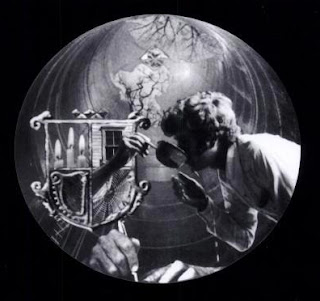
Philippe Grandrieux's "La Vie Nouvelle" (2002)


Let me begin by quoting a part of the lyrics of the famous French song sung by a client of Melania: Jean Ferrat's Aimer à perdre la raison, from a poem by Louis Aragon. I don't find the poem, or the song, that beautiful in themselves, but they mean a lot to me as an element of La Vie Nouvelle:

Aimer à perdre la raison
Aimer à n'en savoir que dire
A n'avoir que toi d'horizon
Et ne connaître de saisons
Que par la douleur du partir
Aimer à perdre la raison

Ah, c'est toujours toi que l'on blesse
C'est toujours ton miroir brisé,
Mon pauvre bonheur ma faiblesse
Toi qu'on insulte et qu'on délaisse
Dans toute chair martyrisée.


In short, the first part talks about loving someone so much that you lose your mind, so much that the only thing on the horizon seems to be the loved one. The second part, not sung in the movie, describes the person being loved, who turns out to be broken, injured, insulted and martyrized by the society.

Perhaps the heart of La Vie Nouvelle, and the sublime art of Philippe Grandrieux can be explained by the two verses above. Broken, painful existences in search of love, seeking some form of communion with the other, who have their own miseries. Many people mistake La Vie Nouvelle for a sick porn movie, which it certainly looks like at points, I admit I had to struggle with it a long time. The violence on the screen is near unacceptable, especially because the director is flirting with it. But in fact, and this is clear to me as sunlight, the violence and the abuses in Grandrieux's films are always confessions, exorcisms. The "New Life" being talked about here begins after the discovery of love, or, maybe a phrase that can be used interchangably with love in Grandrieux's cinema, the discovery of an other. The harsh reality that came before only makes this "new life" more meaningful.


As Grandrieux says himself in the wonderful Nicole Brenez interview on Rouge:

"...always this story of what it is to be human, i.e. confronted with alterity, with the Other who is infinitely possible and yet infinitely closed and inaccessible, no matter what one does. And it’s from there that one journeys, works, loves, fucks…"

By the way, "La Vie Nouvelle" is the official French translation of Dante's text "La Vita Nuova", a collection of gorgeous love poems. The hommage seems unmistakable.


Human beings are animals, dogs in La Vie Nouvelle, with potential for extremely elevated feelings. But the lack of these in daily life is the cause of the suffering. This animality, corporality, and the biology that drives it finds its perfect expression in a scene shot with a THERMAL CAMERA, nothing less, so what is recorded on celluloid isn't light, but the heat of human (and/or animal?) bodies. Here's what Grandrieux says about the scene, again from the Brenez interview:


"(...) the principle is that it is no longer light which makes an impression. With infrared photography, you must use an infrared light, a beaming light that illuminates the bodies, and the reflection of that registers on the celluloid. But here, there is no light. It is the animal warmth of the bodies which imprints itself on the celluloid. The scene was shot in total darkness; no one could see anything except me through the camera. All the participants were in an absolute blackout, and they moved around in a deranged state."


Adrian Martin's incredible article at Kinoeye touches at the heart of the matter. Reading the following paragraph the first time brought tears to my eyes, because it is so accurate, and reminds moments at the very extremes of my cinematic experience. The "French client" he talks about in the last sentence is the one singing the song Aimer à perdre la raison:

"Mise en scène—the art of bodies in space—is always, subtly or overtly, a dance, but this is the dance of death, the living death of everyday power relations. The two scenes of Mélania's prostitution, one placed directly after the other in Grandrieux's cinema of cruelty, provide an inventory of bodily postures figuring fright, uncertainty, panic and stress, a primal, physical language of animals under threat: Seymour's instant post-coital blues, Mélania's vulnerable nakedness, and the icy upper-body stress of the French client, who finally withdraws into himself and away from the Other in order to masturbate in a fuzzy, atomised blur."


Here's Grandrieux talking about the making of La Vie Nouvelle (Brenez interview):

"The film was made under the sign of enormous heat, vital energy, the blazing sun. That surpasses desire, it is even more archaic and formative; it comes from the sun itself, from a star beyond us that we aspire to, in a totally chaotic way. This aspiration towards great energy and happiness, it infused the film, which we made in a wild state of joy, six weeks of shooting like a single stroke, without a second thought [arrière-pensée]."


And finally, and again from the same interview, here's a quote by Grandrieux you might have encountered elsewhere on this blog, one of the finest ideals ever set for art:

"Not a film like a tree, with a trunk and branches, but like a field of sunflowers, a field of grass growing everywhere."

Saturday, June 12, 2010

Claire Denis on narrative in cinema


I haven't really made up my mind about Claire Denis. Her films are fascinating and subtly cinematic but they also seem a bit formulaic, which is why the films don't leave me fully satisfied. Then again, I only saw two films of hers, so I shouldn't even write about the subject. What's certain is that I wouldn't miss it if any Claire Denis films were playing somewhere close on 35mm.


This is something Eytan sent me this morning, it's one of the best descriptions of how I approach narrative in cinema. From Jonathan Romney's interview with Claire Denis (bold emphases are mine):

Jonathan Romney: But the way you tell stories, you don't make it easy for the audience. I saw Nénette et Boni the other night, and what's amazing about that film is that it's a very simple story. A brother and a sister and they meet again. But we don't know everything about them. You take out all the things that other film-makers would put in so we know where we are. We don't know where we are in this film and we have to find ourselves, we have to find the story. Is that a conscious process?

Claire Denis: It's conscious and unconscious. Because again I am not trying to make it hard. I hate that. But I am trying to float on the impression of what a story could be. But for me, cinema is not made to give a psychological explanation, for me cinema is montage, is editing. To make blocks of impressions or emotion meet with another block of impression or emotion and put in between pieces of explanation, to me it's boring. Again, I am not trying to make it difficult but I think, as a spectator, when I see a movie one block leads me to another block of inner emotion, I think that's cinema. That's an encounter. I think cinema is linked to literature by a lot of social ways. Our brains are full of literature - my brain is. But I think we also have a dream world, the brain is also full of image and songs and I think that making films for me is to get rid of explanation. Because there is, I think, you get explanation by getting rid of explanation. I am sure of that.


Something I wrote on a_film_by four years ago:

"Here's my problem with taking 'the story' too seriously. As Zach [Campbell] points out, what we call the story of a film only exists in our minds. What there really is in the film is bits and pieces of information/happenings. Those can be taken in time-based cause/consequence relationships and we have a story.

OR we can take those in a more poetic way, as a continuous flow of thought/feeling/images that sometimes create interesting effects not because they construct a story but just because they contrast or draw parallels between different ideas.

And I'm not talking about contrasts/parallels between different scenes. It could be that in the same scene, same shot, different thought/feelings might be aroused by different elements.

If a character expresses regret by the way she looks in a funeral scene, what we have is more than that character feeling regret during a funeral. We have the ideas of regret and death meshed together, which creates a different idea impossible to express in words. This would, of course, have to be helped by the composition since cinema is a cinematic medium.

I find that most of my favorite narrative films also work in this poetic way. Au hasard, Balthazar, Viaggio in Italia, I Was a Male War Bride, Some Came Running, The Birds, Objective, Burma! are all great examples of this."


Or we can summarize all this thanks to a simple quote by Jean Mitry: "Le roman est un récit qui s'organise en monde, le film un monde qui s'organise en récit," Tag Gallagher's translation: "The novel is a narrative that constructs a world; film is a world that constructs a narrative."


Monday, May 31, 2010

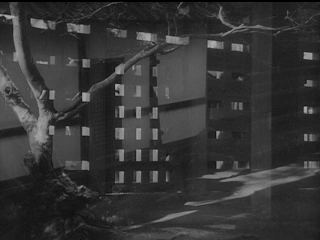
Douglas Sirk's "A Time to Love and a Time to Die" (1958)

Buildings define spaces, and they are crumbling. War is Hell, and the lighting is Hell in A Time to Love and a Time to Die.


The only paradise is in the short moments of peace the lovers have, which are usually cut off by sirens or the bombs exploding. Still, the blossoming flowers appear everywhere...


About Sirk's The Tarnished Angels, I had said: "I felt so fragile, as if everything could break like a glass at any given moment". The same here: The whole world, everything we build might crumble down at any moment. True, this is a story at a time of war, a time of absurdity, but if we are in a world where such absurdities can happen, what does that tell about the every other moment in history? Isn't it pure luck for the lucky few that things are standing still... And what is it worth, if it's just pure luck?

Intricacies of composition, visual puzzles, filled with ruins, or the standing artifacts of civilisation (especially the museum...). Binding's house as a perfect example of how the materiality around is such a lie, just an extension of human egos (Tag Gallagher talks about "Wills"), threatened by an absurd destiny (which is forewarned by the title itself). Life itself is only a reflection, and Love slips away, even though we're trying to hold on to it (i.e. the last shot of the film).

Like Stan Brakhage says in Telling Time, aesthetics and empathy are one and the same. Film-aesthetics, not as a collection of pretty pictures, but as a rhythmic succession of durations, a perception of time-itself ("A Time to... and a Time to..."). And empathy (Tag Gallagher talks about "understanding"), not only for the characters whose stories we're watching, but also for a vision of the world (Douglas Sirk's, in this case).

Similarly, Tag Gallagher reminds us that the Greek word "Melodrama" actually consists of two words: "Melo" (meaning "Music": rhythm, form...) and "Drama" (emotions, identification, conflicts...).

There is joy in the experience of A Time to Love and a Time to Die, a dark, frightening joy...

Thursday, April 29, 2010

Semih Kaplanoğlu's "Yusuf Trilogy" (2007-2010)


Yesterday, I went to see Bal (Honey) for the third time.

I went there because I felt like I needed the movie, because it was the only real thing around. Bal would offer me a ride to the very essence of things, while everything else seemed bland... I needed therapy, and it was with this mindset that I went in, not knowing what to expect, except to be healed... Healed I was when it was over.


Now that I'm getting familiar with it, the road it offers feels less bumpy, like a free-flowing conversation. This familiarity does not ruin the experience at all, it breeds no contempt, no boredom. It's the other way around, Bal feels closer and closer to home, like a memorized prayer that gets more elating each time it is read (not that I'm a religious person in any way). Is it just coincidence or a case of selective attention that I ran into the following two quotes by Beckett today?

“All poetry, as discriminated from the various paradigms of prosody, is prayer.”

and

“...art has nothing to do with clarity, does not dabble in the clear and does not make clear.”

In his thoughtful article on Semih Kaplanoğlu's Yusuf Trilogy, Fatih Özgüven gives us some clues on how to approach these seemingly distant films. Here is my own summary of what he says, or rather, what I understand from it:

The trilogy consists of three films with peculiar titles: Yumurta (Egg), Süt (Milk), Bal (Honey). The following explanation for the titles only work in the context of the trilogy as the films create their own meanings:

Honey represents the Father, who acquires his knowledge of the world through work (the bees are working and Yusuf's father works in order to obtain honey and teaches his son how to). Milk represents the Mother who has a more innate knowledge of life, just as milk comes naturally. She is also the one insisting that Yusuf drinks milk. Egg is life, or birth, which can only happen through the coming together of what's innate and what's acquired.

This above paragraph can be taken as a mythology of how human beings are created, OR as a mythology of how artworks are created. To draw the parallel between art and life isn't very hard here, especially since Yusuf will become a poet. The distinction between life and art is superfluous anyway.


The expending symbolisms above work as clues to the trilogy, they clarify, but shouldn't be taken too far. Semih Kaplanoğlu's films also appreciate the thingness of things. So, in a way, an egg is an egg, milk is milk, honey is honey... Quoting D.H. Lawrence:

“Life and love are life and love, a bunch of violets is a bunch of violets, and to drag in the idea of a point is to ruin everything.”


When I first heard that a Turkish film-maker whose works I had not seen before was going to make a trilogy with the titles Egg, Milk and Honey, I thought it was ridicule, a poor attempt at something. Now with Bal, it all seems so very clearly, unshakably profound. In Bal, there is a scene in the classroom where a girl reads a paragraph from a textbook. It goes something like this (as much as I remember): “We eat food in order to obtain our energy. Without them we would be incapable of doing ordinary things such as walking, running, playing...”

So foods are not just foods, we exist thanks to them, they are our connections with other species, or the outer world in general. They are connections that become part of us. Notice that eggs, milk and honey are all foods obtained from animals (without actually killing them; animal meat is always gross in the films). As shown in the trilogy, human beings also use food for spiritual purposes in their rituals, as if they have metaphysical powers.


(SPOILERS in the following paragraph:)

Our senses are another connection we have with the outer world, and they are also metaphysical. Little Yusuf rings a little bell, supposedly hoping that it will somehow bring his father back. He shuts the light on and off in the evening, as if he's hoping his dad will appear all of a sudden (just like in his dreams). He also learns to taste honey, feels a need to embrace the trees... The first poem he ever hears is a Turkish translation of Arthur Rimbaud's Sensations:

“On the blue summer evenings, I shall go down the paths,
Getting pricked by the corn, crushing the short grass:
In a dream I shall feel its coolness on my feet.
I shall let the wind bathe my bare head.

I shall not speak, I shall think about nothing:
But endless love will mount in my soul;
And I shall travel far, very far, like a gipsy,
Through the countryside - as happy as if I were with a woman.”


The film ends with the sound of breathing dissolving into the sound of the forest.

For me, first and foremost, Semih Kaplanoğlu's Yusuf Trilogy is about the line between us and the outer world, or rather, about the fact that such a line actually does not exist.


I find it best to end with Semih Kaplanoğlu's own words about the Yusuf Trilogy, partly because it mentions layers I didn't even talk about here:


“Seeing at the Forum section of the 55th Berlinale, where my second film "Angel's Fall" had its world premiere in February 2005, how some directors look upon their own provincial towns opened new horizons for me.

Soon after my return home, I started writing about the Anatolian provinces; the short stories I wrote created a trilogy. The three, feature-length films will be titled Honey, Milk and Egg. I intend to begin the shooting with Egg, the third chronological story in the trilogy. The films will be shown in reverse order, i.e, as Egg, Honey and Milk.

What I'm looking at here is a longish cinematographic flash-back. Call it an internal journey, if you will, towards the authentic and away from the globalising face and appearance of the world's provinces. For it is in our provinces that the feeling of time, so eroded by civilisation, still clings.

This will also be something of an archaeological dig, extending from the last days of the mother-son relationship (with the death of the mother in Egg) to the beginning (the birth of the son in Honey). I hope in this way to narrate the burden and pain of passing time so that I may be able to invite everyone to remember and think about his own time. We all have mothers we love and it is highly possible that much is hidden in the time we spent with our mothers, and the time we are no longer able to spend with them.

I wish to note that my films are not only bound to the story, that is, the screenplay. I am of the view that time is the raw material of cinema. My expression is plain, spare in dialogue, shaped by visual and audio details and focused on conveying the sense of time passing with every breath.”


Saturday, April 24, 2010

Semih Kaplanoğlu's "Bal" (2010)


English title: Honey

It's a film that deserves multiple viewings but I'd just like to react to my first viewing. Warning: This post has SPOILERS!


Who would have guessed that the trilogy would end anti-climactically, down-beat, dissolving into life itself, with the sound of breathing...

As Cihan said beautifully after the film, you fall down into the film after a while, and there is no turning back.

Primitive, expressive, conscious, depressing and joyful, Kaplanoğlu's last film is not about anything. It is off life itself.

Primitive it is, somehow reminding us our primal reactions to nature, to parents, to language, to poetry. Before consciousness.

A film OFF life, its depressive nature also offers joys, some urgency, and a blatantly sensual beauty grasping the eyes first, then the mind, and later my philosophy of life.

In a Semih Kaplanoğlu film, expect to learn to be patient... And find out for yourself how that minute attention later spills over to the rest of things in your life.


Monday, April 12, 2010

29th International Istanbul Film Festival


I'm seeing a lot of films these days, thanks to the Istanbul Film Festival. I'll just list here the films I like. Will update this post as I see more. In an arbitrary order of preference:


Sublime:
Around a Small Mountain - Jacques Rivette


Great Films:
Five Fingers - Joseph Mankiewicz
Homage by Assassination - Elia Suleiman
Nymph - Pen-Ek Ratanaruang


Good Films:
Chronicle of a Disappearance - Elia Suleiman
Divine Intervention - Elia Suleiman
The Time That Remains - Elia Suleiman
Bad Lieutenant: Port of Call New Orleans - Werner Herzog
Mother - Bong Joon-ho
White Material - Claire Denis
Istanbul shorts - Maurice Pialat


I'm not sure what I feel about:
Face - Tsai Ming-Liang
Karaoke - Chris Chong Chan Fui


Friday, April 2, 2010

Hou Hsiao-hsien's "Millennium Mambo" (2001)


According to Wikipedia, the word "mambo" has at least two meanings:

In the Voodoo religion in Haiti, it refers to
the female high priest, "whose responsibility it is to preserve the rituals and songs and maintain the relationship between the spirits and the community as a whole (though some of this is the responsibility of the whole community as well). They are entrusted with leading the service of all of the spirits of their lineage."

As a "
music form and dance style", "the word derives from a ki-kongo based language, the language spoken by West-Central African slaves taken to Cuba". It means "conversation with the gods".


Whichever one Hou was thinking when he titled his Millennium Mambo, he was trying to make a film about modern life where the main purpose was to have an interaction with the invisible spirituality beyond the visible world (through the character of Vicky, if we accept the first definition).

Actually, again according to Wikipedia, the word is also a greeting in Swahili 'commonly used by young people in East African countries especially Tanzania and some parts of Kenya. It's considered a slang greeting, and translates to "things?" as in "how are things?"'. Is this Hou saying "Hello!" to the new millennium and asking, somehow ironically, "how are things"?

All of these work as explanations... I'm sure there could be others.


Bland lives, lived without hopes, without love... Lives spent smoking cigarettes, perhaps because dying isn't necessarily worse than living... Meaningless music all around...

Millennium Mambo is a film of despair. The only character who seems to have real hopes about life is a 80 year old grandma living in a village far from the urban landscape. Not so surprisingly within the context, and considering Hou's love for cinema, this same village also has a film festival.

It is a film of despair, a continuation of his previous film
The Flowers of Shanghai (1998) in lots of ways, just in a different time period. I'd like to point out that the films that will follow Millennium Mambo will all have very joyful, happy, hopeful, and loveful moments, just as there are in earlier movies, beginning from The Green, Green Grass of Home (1983). There are many films of his I haven't seen but I guess it wouldn't be a mistake to call this period a relatively depressed point in his filmography.


The moments of joy in
Mambo are all too brief to give us hope, they look almost as a revolt to the blandness all around. In a film like The Flight of the Red Balloon, six years later, there is real faith in human warmth and the power of love.


You can find here Andrew Schenker's wonderful blog post about the sound on Hou's Millenium Mambo.

Semih Kaplanoğlu's "Herkes Kendi Evinde" (2001)

English title: Away From Home

There is a moment in Semih Kaplanoğlu's first feature film Herkes Kendi Evinde that announces a great filmmaker with a new vision of cinema.

It comes somewhere in the middle of the film. (SPOILERS ahead.)

We've met Olga, a Russian girl in Istanbul in search of her father. She needs about 300 dollars to go back home, but she doesn't have the money. She first tries selling her camera, it doesn't work out. So she decides to sell her body for the first time in her life. We see her dressing up, doing make up, looking at herself in the mirror. In the next shot we watch her (for about 6-8 seconds) on the street with other prostitutes, looking at the cars passing by, trying to find a client. CUT.

SLOW FADE IN to a slightly high-angle medium-long shot of Olga lying on the grass, unconscious. Her dress is messed up, her legs dispersed, she's not moving. There's no doubt, she's been "used", and there's very little doubt that the person who raped her didn't pay her any money. It's a very sad, horrifying image, empowered by a perfectly executed ellipses, worthy of its greatest uses in the history of cinema. It underlines the tragedy while keeping a distance, without dramatizing, certainly not cheapening.

But the camera keeps rolling. Nasuhi slowly comes into the frame from behind the camera, when we realize that we've probably been in slow-motion the whole time (the "whole time" lasted only about fifteen seconds). Nasuhi is a character we know from earlier, he is a nice old man, who came back from Russia, to find his old house near Istanbul. It's unlikely he knows Olga from before, but we know he might help.

How is it that he happens to be there? (a question never answered in the film...) Did the worse nightmare possible just turn into a calm fantasy? Is this a dream? (this last one should sound familiar if you've seen any other Kaplanoğlu films)

But it turns out it's not "a dream": their meeting will change the course of events for both of them, on the way to a quiet and internal half-redemption at the end. Their sense of exile will continue forever...


As it should be obvious to anyone who has seen it, Herkes Kendi Evinde is an imperfect film. There are clearly unintended flaws in the lighting, editing, acting, story-line, etc. Just the titles at the end are funny to watch, in a way, because of the spelling mistakes all around. Nevertheless, the core of art resides somewhere other than these, and a clumsy film such as this can take us to levels that accomplished productions can't even imagine.

Happily, four years later, Kaplanoğlu's next film Meleğin Düşüşü (Angel's Fall) will have nothing clumsy about it. It's a perfectly realized masterpiece.

I want to thank Tarık Zafer Tunaya Kültür Merkezi (Tarık Zafer Tunaya Cultural Center) in Istanbul for giving us a chance to see these amazing films on 35mm.

Friday, March 26, 2010

about Robert Breer's films and his awareness of time


In this post, I'll try to talk about an aspect of Robert Breer's cinema. You know this already if you've seen his films, but please keep in mind that there are many other aspects to his highly expressive, sensual, imaginative, personal, joyful, humorous art. Trying to unify them all in one post is beyond my scope, and perhaps it would contradict Breer's multi-faceted films themselves.


A few years ago, when I made my top ten list for the Senses of Cinema, I ranked Robert Breer's What Goes Up? (2003) as my second favorite film of all time, and on my note for it, I said:
'If frame is the unit of cinema, what happens between frames deserves higher attention.'
Now, after three years, I'd like to elaborate on this.

Almost all of Robert Breer's films are animations that at some crucial points draw attention to the succession of frames. One of the strategies he keeps using repeatedly is this:

Imagine an animated movement A (i.e. a red square going up). The successive frames that create the illusion of the movement A are called A1, A2, A3, A4... Also imagine an animated movement B (i.e. a black line going from left to right). The successive frames that create the illusion of the movement B are called B1, B2, B3, B4... (Warning: the frame 'B4' should not be confused with the formula in Howard Hawks's Monkey Business)

Now imagine the corresponding frames from the movements A and B superimposed. So A1 is superimposed with B1, creating a new frame AB1; A2 is superimposed with B2, creating a new frame AB2, etc. The new frame-images can be projected in succession: AB1, AB2, AB3, AB4...

But this isn't what Breer does. Instead he does this:

A1, B1, A2, B2, A3, B3, A4, B4...


The mind's eye still sees a similar superimposition of the movements A and B, but it feels different than the previous example. Especially when seen on film, the brain somehow feels a vibration, and if the eye is trained enough, one can actually see that these are separate frames that follow each other really fast.

What happens in between these successive frames depends on the individual brain (my whole point?). Ideally, the eye shifts between complete darkness and the bright frames (Breer usually uses white or some other bright color as his background). This shift happens gradually (quickly, but still gradually) because of the residue the images leave on the mind. This residue is the only reason why we think the image stays on the screen for more than 50% of the time. In fact, the screen is black half the duration of the film (any film!).

What I'd like to stress is that we're talking about very minute lengths of time here... Less than 1/48th of a second at most...

This also contradicts, in a way, with my statement above that frame is the unit of cinema. When we are watching a Breer film, both the frames and the blacks, and everything in between, become separate units, or to take the idea to its natural conclusion: There are no units in cinema (or other time-based arts), it's simply a continuous event.

Can you give me other examples from life or art when we care about such miniscule time-lenghts? Or when something asks us to feel these? I bet you can't give that many... (and calculating these lengths scientifically has nothing to do with the actual experience of actually feeling these...)

My whole point is that Robert Breer, along with some others such as Stan Brakhage (especially in his hand-painted works), Peter Kubelka (Arnulf Rainer), Harry Smith and Larry Jordan (their flickering animations), has created an experience of time that humanity had not know before, or has cared very little about.

Just to stress my point, I'd like to mention Breer's kinetic sculptures... His kinetic sculptures move too slowly for the mind to perceive. But when you watch them for a time, you'll notice that they have changed places. I've never seen one in reality but I assume that this kind of work asks its 'audience' to try to capture, imagine, feel the movement, or actually, the time itself... Breer wants you to CARE about the time passing.

Just as Hollis Frampton said that all film (film itself, not the soundtrack) is about light (how can they not be when all they are is light reflected from the screen), one can state that all time-based artworks need to be 'about' time, or rather, to make this less polemical, and more reasonable, at least they need to be AWARE of it.

Personally, I know very few artists who were as aware of time as Robert Breer is.

Someday, I'd like to write about the other aspects of his work, especially about the unique sense of rhythm in his films...

The reason I chose not to use any images in this post is that no number of frames can get at the sense of duration I tried to explain above. They would in fact contradict my whole purpose.

I would also like to say that what I'm saying above is not new in any way. Fred Camper, P. Adams Sitney, Stan Brakhage, Peter Kubelka and Robert Breer himself have described the above phenomenon and its implications much more successfully. Read their writings...

Here is a great article on Robert Breer by Fred Camper, where he writes:
'I can think of a few filmmakers whose work offers universes as complete as Breer, but none whose work seems more ‘complete.’ Breer weaves together daily seeing and abstract forms, depth and flatness, movement and stillness, sound and silence, coming together and falling apart, success and failure. Sitney has suggested that the project of avant-garde cinema is a mimesis of human consciousness, and along with Brakhage, Breer offers as complete a realisation of that aspiration as we have yet seen — in the form of “visual orgasms” which, filled with delight and surprise, also cause the viewer to reflect on seeing and thinking.'


Best of the year 2010... and posts I like from other blogs...


Firstly, I've created a page for my favorite films & videos of 2010. On top of it is Ekrem Serdar's incredible film The Destruction of the Russian Monument at San Stefano: Daughters, which I unfortunately had to see on video. I invite all of you to check his last video work (Secret Location) Postcard.

Also, I started sharing the posts I like from other blogs. These usually are some inspiring stuff on the films & filmmakers I like. You can always check the sidebar here on the right to see the last ten shared items. You can subscribe to my shared items feed here.

Also on my sidebar is my recent Twitter posts.